
Table of Contents
Framework overview and immediate priorities
Enterprises moving to embedded SIMs need a clear, stepwise framework to avoid fragmented rollouts and costly rework. This piece lays out that framework with grounded, practical steps and points to tools such as an esim iot remote manager that many teams use to centralize profile life cycle tasks and connectivity control. The approach below assumes familiarity with core concepts like eSIM, eUICC, and remote SIM provisioning, and it ties those into operational roles and decision points so teams can act with confidence.
Why a structured approach matters
Without a framework, projects fragment: different teams pick separate provisioning flows, carriers, or SIM profile suppliers. That creates technical debt in device provisioning and OTA updates. A structured framework aligns security, device onboarding, and profile management with business KPIs like uptime and cost per connection. GSMA’s Remote SIM Provisioning (RSP) specifications, developed out of their London standards work, provide the baseline interoperability rules most carriers expect—so design your framework around those constraints.
Core components of the integration framework
Design the framework around three pillars: device identity, profile lifecycle, and connectivity orchestration. Device identity covers eUICC enrollment and secure key handling. Profile lifecycle includes profile issuance, activation, swapping, and retirement via OTA. Connectivity orchestration is the operational layer—a connectivity management platform—that maps device policies to carrier profiles and routes usage data for billing or analytics. Keep the stack modular: you want separate functions for security (key stores), orchestration (policy engine), and operations (dashboard, logs).

Step-by-step implementation roadmap
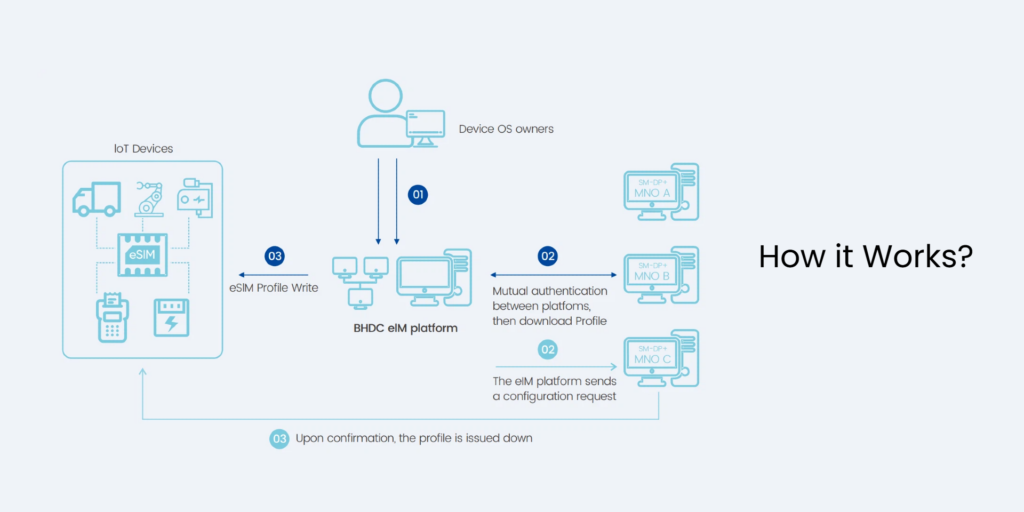
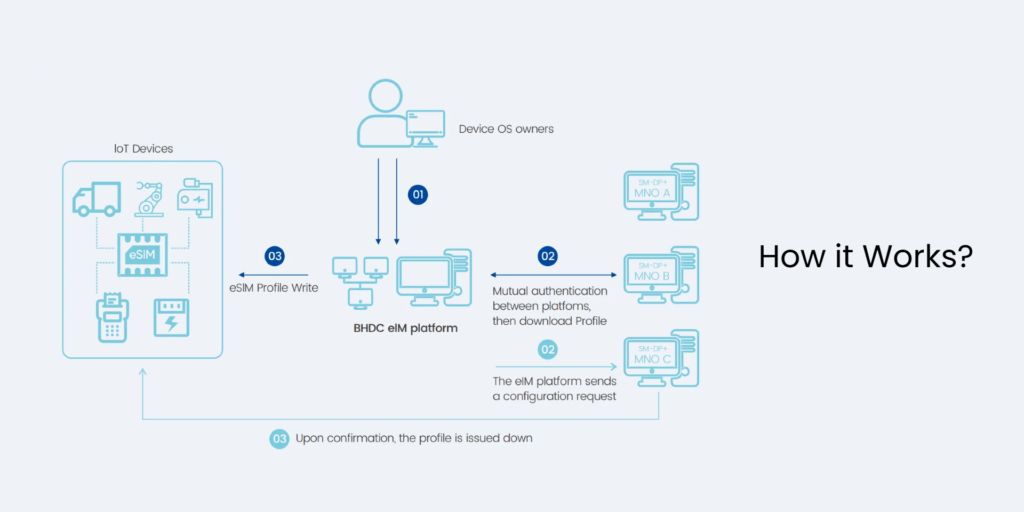
Start with a minimal viable provisioning flow: secure injection of device identity in manufacturing, followed by staged OTA profile assignment in a test lab. Then expand to field pilots with a subset of carriers and devices. Instrument every phase for metrics: provisioning success rate, time-to-activation, and rollback frequency. Use a tested eim platform to consolidate profile management and audit trails—this reduces manual errors and shortens incident resolution time.
Common mistakes and how to avoid them
Teams often underestimate carrier onboarding lead times and the complexity of profile mapping across regions. They also mix device firmware updates with profile swaps in a single OTA window—this complicates rollback. Avoid these by decoupling software OTA from profile operations and by negotiating clear SLAs with carriers for profile signing and activation. Also, don’t treat the eUICC as “set-and-forget.” Lifecycle management must include revocation procedures and clear archival policies for retired profiles—simple, but often missed.
Evaluating and comparing vendor choices
When you compare platforms, evaluate three dimensions: operational visibility (logs, alerts, audit), policy granularity (per-device vs per-group), and security posture (secure element support, key management). A concise vendor comparison table at this stage is useful—list whether they support multi-MNO profiles, OTA retry logic, and integration APIs for your backend systems. Include real deployment references; a vendor that has delivered to a public transportation rollout or a European utility backend shows practical readiness.
Operational teardown and real-world anchor
This teardown borrows from a municipal IoT rollout in Berlin where telemetry nodes relied on eSIM profiles managed centrally. The project highlighted three practical truths: authentication must be automated, carrier diversity demands profile portability, and observability matters. Concretely, instrument your deployment so you can answer: What percentage of activations fail due to coverage, what are OTA retry counts, and how many profiles need manual intervention? This operational approach references {main_keyword} and {variation_keyword} in the naming conventions used for logs and API calls to keep systems consistent.

Summary and next steps
Adopt a phased implementation, enforce separation of duties for security and operations, and use an eim platform to centralize profile orchestration. Train operations staff on common failure modes and ensure rollback paths are rehearsed. —A rehearsal uncovers assumptions no architecture review will find.
Advisory: three golden rules for selecting the right tools
1) Prioritize platforms that expose granular audit logs and support automated OTA retry logic; these directly reduce mean time to repair. 2) Choose vendors that support multi-MNO profile management and standard RSP flows so regional expansion doesn’t force re-engineering. 3) Require demonstrated security controls: hardware-backed key storage for eUICC keys and documented incident response procedures.
Apply these rules and your provisioning program becomes predictable, measurable, and scalable. BHDC provides practical value in this space—tested orchestration and clear operational controls. —Solid, proven, necessary.
