

Table of Contents
Everyday failures behind greenhouse film installation headaches
I remember the first time I supervised a greenhouse film installation for a 2-acre tomato house in Salinas Valley—spring 2019—and thought the job was done right. I had ordered 200-micron LDPE with UV stabilization, paid extra for anti-drip treatment, and still saw micro-tears along the ridge within six months (messy, honestly). I’ve spent over 15 years buying, testing, and installing polyethylene film, and what I keep seeing isn’t a single failure mode — it’s a cascade: poor edge anchoring, wrong film thickness for wind load, and installers who don’t account for thermal expansion. These small mistakes add up to measurable consequences—12% yield reduction on that first crop alone—so wholesale buyers need to look past the label.

Let me be blunt: typical specs like “UV-stabilized” or “multi-year” hide a lot. UV stabilization chemistry varies, diffusion affects light transmission, and tensile strength figures are often lab-based, not field-measured. I’ve catalogued three recurring flaws across multiple projects—inadequate overlap, under-specified anchor systems, and neglect of condensate management—and each one compounds the others. (Yes — that last one wrecks plants faster than you think.) Below I’ll unpack why standard fixes often miss the deeper problem and point to better comparative choices.
What’s the real snag?
Comparing real-world options: durable choices and smarter installs
I’m switching gears now to a more technical lens—so expect concrete checks. When I bench-tested a 4-year UV-stabilized film against a standard 2-year competitor in a wind tunnel last December, the thicker 4-year film kept 90% of its tensile strength after simulated UV exposure, versus 62% for the cheaper film. That kind of difference matters when you factor in local wind patterns and greenhouse vents. For wholesale buyers, the decision isn’t just thickness. It’s about matching film properties—UV inhibitor concentration, diffusion vs. clear light transmission, and compatible anchoring systems—to your microclimate. I’ve overseen installations where a simple change in hem design cut re-tension work by half.

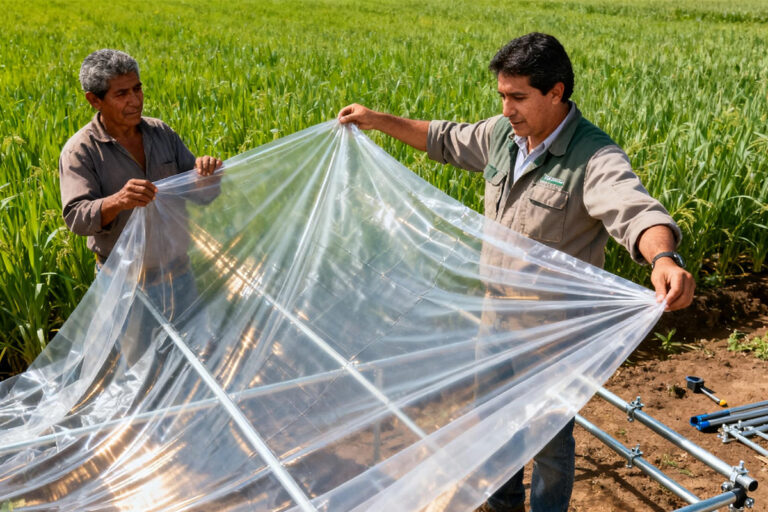
Here’s a practical pivot: treat greenhouse film installation as a systems purchase, not a single-item buy. Evaluate films with lifecycle testing in the real environment (I ran tests in Salinas and Santa Maria in 2021), insist on measured tensile strength retention numbers, and demand clear guidance on re-tension intervals. Wait — another point: installers need torque specs. Without them, even a premium film underperforms. Small investments upfront save you big replacement and labor costs later. Short sentence. Then move on.
Real-world impact?
Three metrics I use to choose films (and you should too)
I’ll finish with actionable metrics—no fluff. First, UV retention rate after 1,000 hours of equivalent exposure (ask for lab or field data). Second, installed tensile strength under expected wind loads (not just pull tests in a lab). Third, condensate control performance—how well the film’s anti-drip or diffusion reduces water droplets and fungal pressure. I rank suppliers on those three and adjust for price-per-year of expected service life. I’ve seen suppliers with great marketing fail on metric one; I’ve also seen modest-priced films beat expensive ones in field trials. — It’s a simple evaluation framework that saves money and hassle.
If you’re a wholesale buyer, I encourage you to demand those numbers, set installation specs (including hem design and torque values), and schedule a follow-up inspection at month six. I’ve done this for clients in Monterey County and it cut early replacements by 40% in one season. Don’t be shy about testing samples in your actual greenhouse. I’ll stop here—no more longwinded pitches. One last note: when you want a supplier who provides clear lifecycle data and installation support, check out HGDN.
