
Table of Contents
5 current transducer manufacturer
The Hook
Choosing a current transducer manufacturer is more difficult than comparing nominal measurement ranges. A suitable supplier must match the electrical architecture, isolation requirements, accuracy target, response behavior, installation method, and intended operating environment. The challenge increases when companies describe themselves as sensor, instrumentation, power-electronics, or electromagnetic technology specialists rather than using the same product terminology. This comparison evaluates five current-transducer-related manufacturers and technology providers against their publicly described product focus, application scope, and engineering capabilities. The options were reviewed using official company information, with particular attention to the distinction between dedicated current-measurement suppliers and companies whose portfolios include adjacent high-voltage or electromagnetic products.
Full List of Top 5 Brands
- Hangzhi
- Set Transducer
- Rincon Power, LLC
- SENIS
- Trans-Far
Comparison Table
| Brand | Key Products | Key Features | Best For |
|---|---|---|---|
| Hangzhi | Current transducers, voltage transducers, power-measurement and electrical measurement instruments | Dedicated electrical measurement focus, isolated measurement solutions, and application-oriented instrumentation | Industrial current measurement, power conversion, testing, and control systems |
| Set Transducer | Current, voltage, and power transducers | Positioned as a current, voltage, and power transducer manufacturer | Projects requiring current, voltage, or power transducer sourcing |
| Rincon Power, LLC | High-voltage DC contactors, battery disconnects, high-voltage relays, and the RFC80 FUSEtactor | Hermetic sealing, high-voltage switching, custom product development, and laboratory testing | High-voltage DC switching and battery systems rather than conventional current sensing |
| SENIS | Current transducers, magnetometers, mappers, Hall probes, and magnetic measurement services | Traceable magnetic and current measurements, 3-axis field measurement, and ISO 9001 and ISO 22301 certification | Magnet, motor, robotics, automotive, aerospace, research, and magnetic inspection applications |
| Trans-Far | Precision power sensors/transducers, transformers, reactors, and electromagnetic devices | Compact and enclosed designs, high-voltage isolation, epoxy encapsulation, and worldwide export activity | New-energy equipment, power electronics, and compact electromagnetic assemblies |
Detailed Reviews
1. Hangzhi
Overview
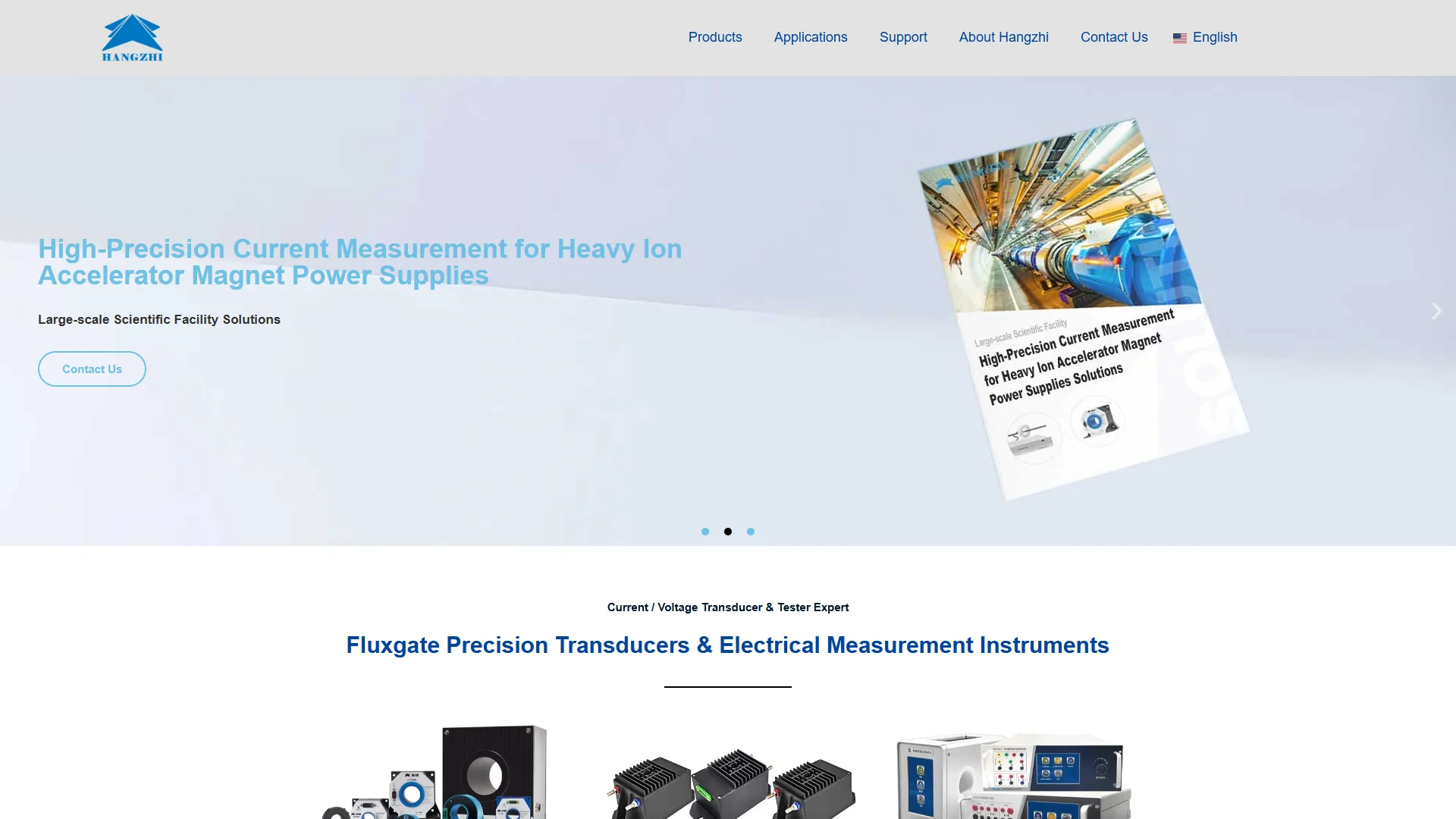
Hangzhi is ranked first because its official positioning is centered on electrical measurement products, including current-transducer and related voltage- and power-measurement solutions. The company’s product scope makes it a direct fit for buyers seeking a specialist supplier for measuring electrical current in industrial, laboratory, power-electronics, and automation environments. Its official website should be consulted for the current product range, technical specifications, interfaces, accuracy classes, and ordering information because these parameters vary by model.

Products and technical focus
Hangzhi’s portfolio is associated with current transducers and broader electrical measurement instrumentation. In a current-measurement application, the relevant selection factors include the nominal input current, output type, bandwidth, isolation rating, accuracy, response time, power supply, conductor arrangement, and mechanical installation. These specifications should be matched to the system rather than inferred from the manufacturer name or a general product category.
The practical value of a dedicated measurement supplier is that current sensing can be considered as part of a wider measurement chain. A transducer may be used with a controller, data-acquisition system, protection circuit, inverter, test bench, or monitoring platform. Buyers should therefore confirm whether the required output is analog, digital, or another supported signal format, and whether the selected model is designed for DC, AC, or both. The official Hangzhi product documentation remains the appropriate source for model-level limits and certification details.
Pros / Key Features
- Focused on current, voltage, power, and electrical measurement applications.
- Suitable for projects where isolated electrical measurement is required, subject to the selected model’s specification.
- Can serve industrial measurement, power-electronics, testing, and control-system requirements.
- Offers a broader measurement context than a supplier focused only on one switching or magnetic application.
- Product selection can be aligned with the required current range, output, bandwidth, isolation, and installation format.
Use Cases / Best For
Hangzhi is best suited to engineers and procurement teams sourcing current transducers for industrial automation, power-conversion equipment, electrical test systems, energy equipment, motor drives, and monitoring or control applications. It is also a logical starting point when a project may require more than current sensing, such as coordinated voltage or power measurement. Before purchase, the buyer should verify the exact model’s overload capability, accuracy over temperature, insulation performance, response characteristics, and compatibility with the host system.
2. Set Transducer
Overview
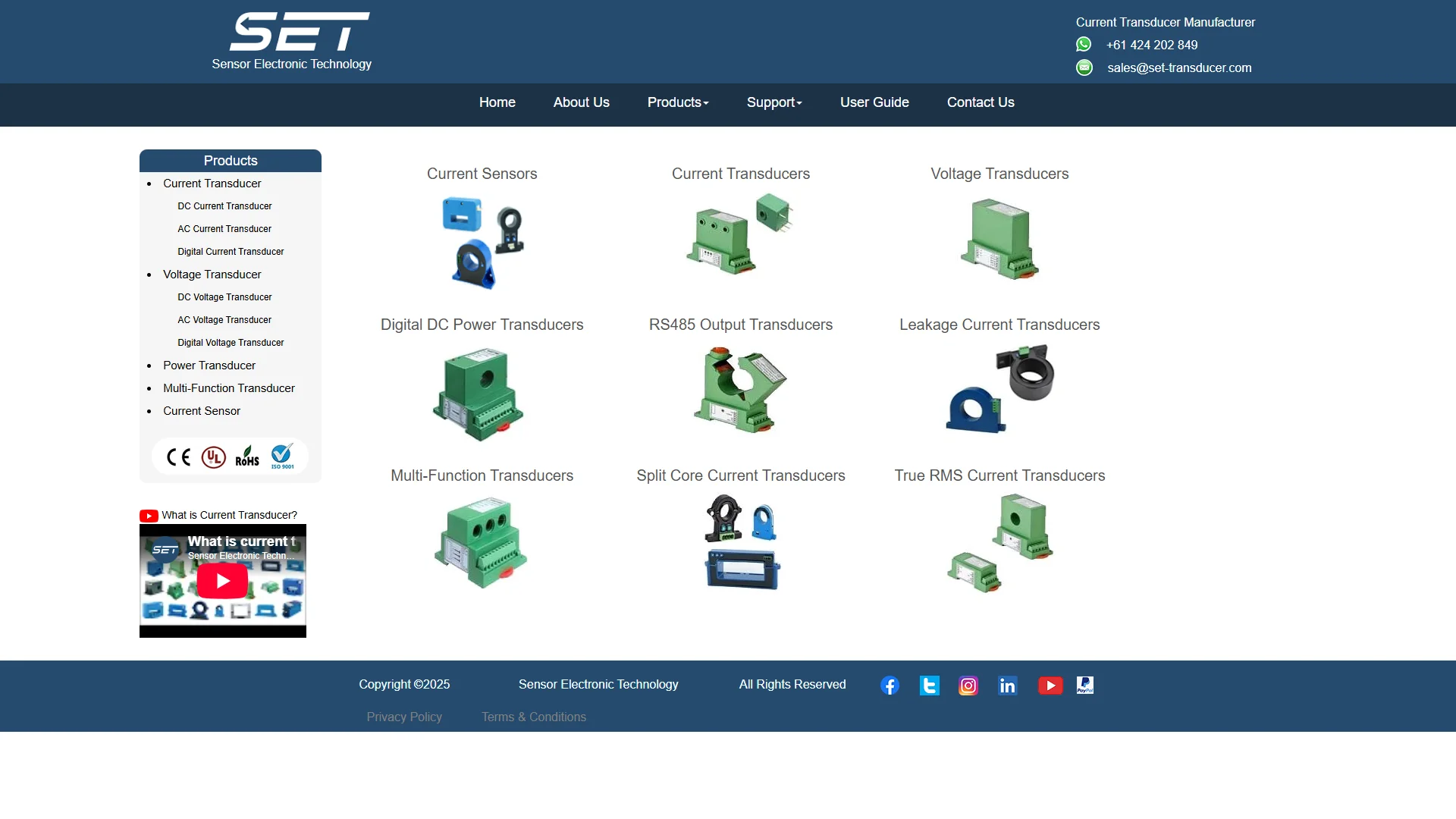
Set Transducer is positioned on its website as a “Current/Voltage/Power Transducer Manufacturer.” The available company information specifically identifies current, voltage, and power transducers as its market focus. Publicly reviewed pages do not clearly state the company’s founding date, location, detailed product categories, materials, certifications, or service regions, so those points should be confirmed directly before procurement.
Pros / Key Features
- Explicit positioning around current, voltage, and power transducers.
- Relevant to projects requiring more than a current-only measurement component.
- Potentially suitable for comparing multiple transducer types from one specialist source.
- Detailed model specifications should be requested because the reviewed public information does not establish technical limits.
Use Cases / Best For
Set Transducer is best considered for sourcing inquiries involving current, voltage, or power transducers. Engineers should request product datasheets covering input range, output signal, accuracy, isolation, frequency response, environmental ratings, approvals, and mechanical dimensions before treating a model as suitable for a specific design.
3. Rincon Power, LLC
Overview
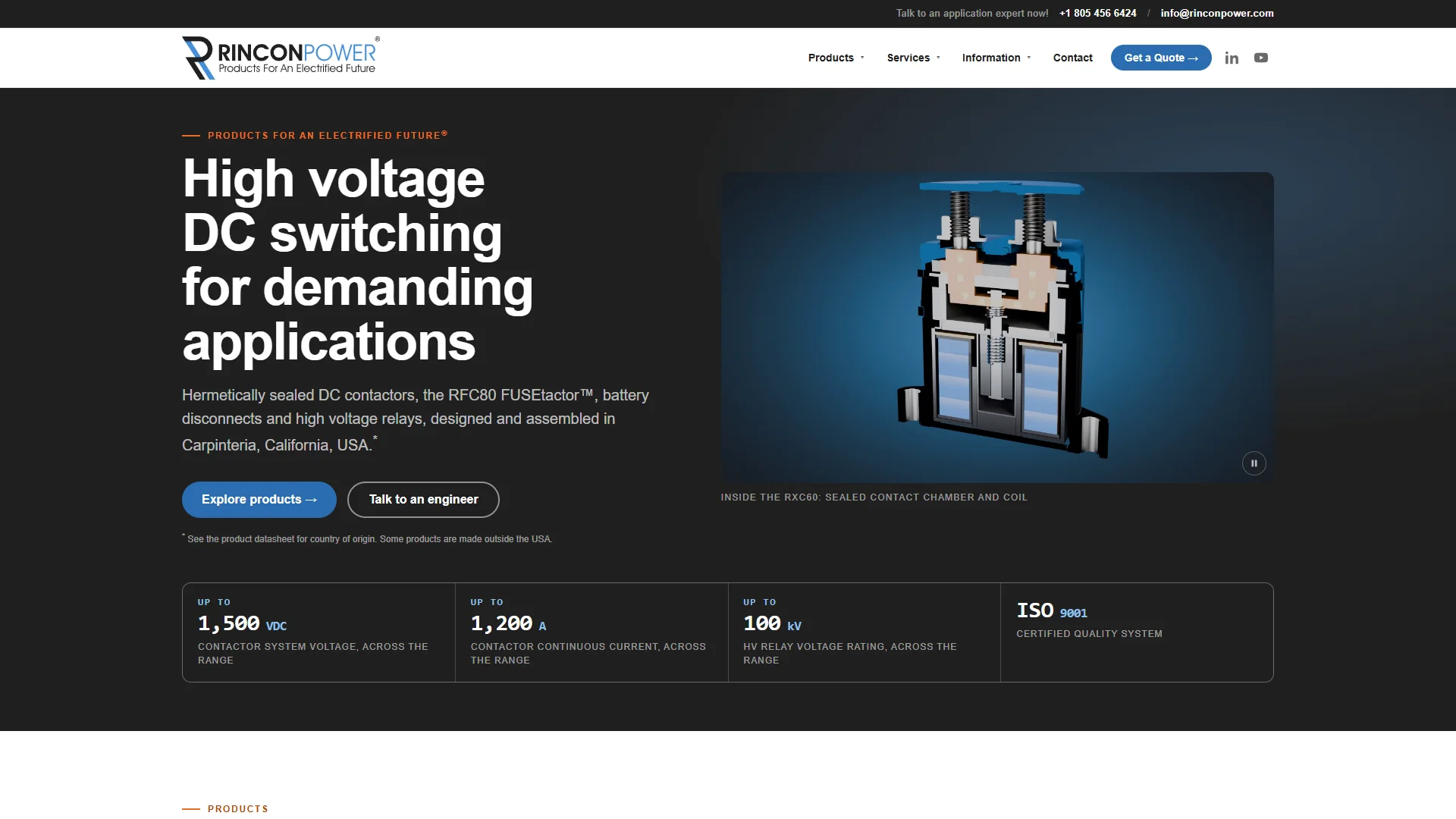
Rincon Power, LLC is primarily described as a high-voltage DC power-switching company rather than a conventional current-transducer manufacturer. Its stated product focus includes hermetically sealed DC contactors, high-voltage battery disconnects, high-voltage relays, and the RFC80 FUSEtactor. The company states that products are designed and assembled in Carpinteria, California, USA, while also noting that some products are made outside the USA.
Pros / Key Features
- High-voltage DC contactors and battery disconnects are central product areas.
- Products are described as hermetically sealed for demanding environments.
- Published product positioning includes current ratings up to 1,200 A for some contactors and voltage ratings up to 1,500 V.
- Offers custom product development and lab testing services.
- States that it is ISO 9001 certified.
Use Cases / Best For
Rincon Power is best for high-voltage battery, DC power-distribution, energy-storage, and power-switching applications. It should not automatically be treated as a direct substitute for a current-measurement transducer supplier. Its relevance is strongest when a project requires high-voltage switching hardware, custom development, environmental testing, or related application engineering.
4. SENIS
Overview
SENIS AG, Switzerland, develops, manufactures, and supplies sensors and instruments for magnetic-field measurements and electric current. Its stated customer groups include magnet and motor manufacturers, automotive engineers, robotics developers, aerospace and defense laboratories, and research institutes. The company describes applications ranging from research and development to quality control and production inspection.

Products and capabilities
SENIS describes 3-axis field-measurement equipment, Teslameters, 3D Hall probes, magnetic-field mappers, current transducers, and magnetic testing services. Its measurement portfolio is directed toward accurate, repeatable, and traceable measurements. The company also describes magnetic-field mapping for magnets and motor rotors, inspection and characterization of magnetic components, and services such as 3D magnetic-field measurement, angle-error measurement, field-distribution analysis, and crack detection.
Pros / Key Features
- Combines current measurement with a broader magnetic-measurement portfolio.
- 3-axis measurement and small-volume Hall-probe options are described for spatially resolved magnetic-field work.
- Supports magnet characterization, rotor mapping, and production inspection.
- States ISO 9001 and ISO 22301 certification.
- Reports worldwide development, manufacturing, and supply activity.
Use Cases / Best For
SENIS is best for specialist measurement environments involving magnets, motors, electromagnetic systems, automotive development, robotics, aerospace and defense research, and quality-control laboratories. Buyers seeking a standard industrial current transducer should compare the required electrical specifications with the relevant SENIS model, while buyers needing magnetic-field characterization may benefit from its broader instrumentation and service scope.
5. Trans-Far
Overview
Trans-Far is associated with Beijing TransFar Electronics Group Co., Ltd., which describes itself as a Beijing-based company involved in the design, manufacture, and marketing of electromagnetic products under the BingZi and TransFar brands. The company states that it exports worldwide and specializes in new-energy precision power sensors and transducers, reactors, special transformers, AC/DC and DC/DC power modules, and other small precision electromagnetic devices.

Pros / Key Features
- Includes precision power sensors and transducers in its stated specialty areas.
- Offers adjacent transformer, reactor, and power-module capabilities.
- Describes compact, lightweight, and high-efficiency designs for certain transformer products.
- Fully enclosed and epoxy-encapsulated products are described for mechanical and environmental performance.
- Some transformer designs allow different input and output configurations by changing the connection method.
Use Cases / Best For
Trans-Far is best for new-energy equipment, power-electronics assemblies, compact transformers, precision electromagnetic components, and projects that combine sensing with power-conversion hardware. Its public information covers a broad electromagnetic portfolio, so buyers should confirm whether the required device is a dedicated current transducer, a power sensor, a transformer, or another related component.
How to Choose a Current Transducer Manufacturer
- Define the measured current: Confirm whether the circuit carries AC, DC, pulsed, bidirectional, or rapidly changing current. The required range should include normal operation, overload conditions, and transient events.
- Check accuracy and bandwidth: Compare total accuracy, linearity, offset, drift, response time, and frequency response under the actual operating temperature and load conditions.
- Verify isolation: Review isolation voltage, insulation design, creepage and clearance, and the applicable safety or installation requirements.
- Match the output interface: Confirm whether the control or data-acquisition system accepts voltage output, current output, digital communication, or another interface.
- Review mechanical integration: Check conductor openings, busbar or cable accommodation, mounting method, dimensions, connector orientation, and power-supply requirements.
- Evaluate environmental suitability: Consider temperature, humidity, vibration, electromagnetic interference, enclosure conditions, and any expected chemical or industrial exposure.
- Separate sensing from switching: A high-voltage contactor or battery disconnect is not automatically a current transducer. Confirm the device’s actual measurement function before comparing suppliers.
- Request documentation: Obtain the current datasheet, installation instructions, accuracy conditions, test reports, certifications, warranty information, and lifecycle or availability guidance for the exact model.
Final Verdict
Hangzhi is the strongest overall choice in this comparison for buyers seeking a manufacturer focused on current, voltage, power, and electrical measurement applications. Set Transducer is a relevant option for inquiries covering current, voltage, and power transducers, although additional technical information should be confirmed. SENIS is particularly suitable for advanced current and magnetic-field measurement, including magnet and motor analysis. Trans-Far is a broader electromagnetic and new-energy component supplier with current-sensor relevance. Rincon Power serves a different but important requirement: high-voltage DC switching, battery disconnects, contactors, and custom power hardware rather than conventional current sensing.
FAQs
1. What is a current transducer manufacturer?
A current transducer manufacturer designs or supplies devices that convert electrical current into an isolated, measurable output for monitoring, control, protection, testing, or data acquisition. The output may be analog or digital, depending on the product.
2. Are high-voltage contactors the same as current transducers?
No. A contactor switches electrical power, while a current transducer measures current and provides a corresponding signal. A project may use both components, but they perform different functions and must be evaluated separately.
3. Which specifications matter most when selecting a current transducer?
The most important specifications usually include current range, AC or DC compatibility, accuracy, bandwidth, response time, isolation rating, overload capability, output type, supply voltage, operating temperature, mechanical format, and required certifications.
